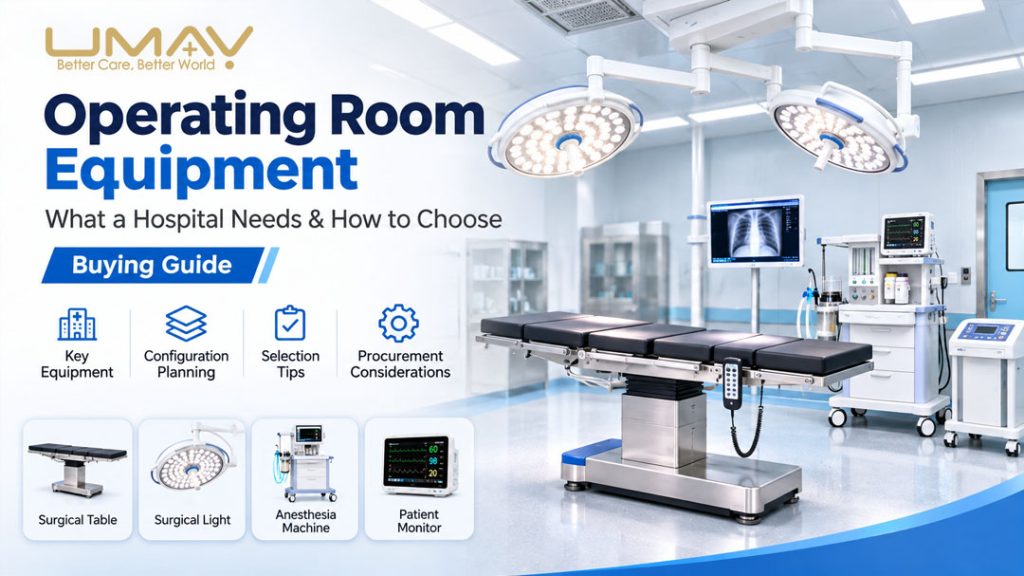
An operating room equipment list usually starts with an operating table, surgical lighting, anesthesia and patient monitoring equipment, an electrosurgical generator and suction. Hospitals also need to plan infusion devices, sterile instruments, emergency support and recovery-area capacity—items that may be missing from an initial supplier quotation.
Before choosing models, list the procedures each room will handle and identify which devices must be available during simultaneous cases. A general-surgery theatre, an ophthalmic room and a minor-procedure room do not need identical configurations. The checklist and two-room example below help buyers compare equipment options and prepare an itemized quotation request.
1. Operating Room Equipment Checklist
Start with the equipment needed to carry out the planned procedures safely and reliably. An operating room inventory should account for devices inside the theatre and the systems that must be accessible nearby. Not everything below requires a dedicated unit in every room; the final layout depends on clinical services, emergency access and hospital policy.
| Equipment group | Purpose in the surgical workflow | What the buyer should specify |
|---|---|---|
| Operating table | Patient support and surgical positioning | Specialties, load capacity, height range, tilt/section movements, attachments and imaging clearance |
| Surgical light | Illumination of the operating field | Single- or dual-head, ceiling/wall/mobile mounting, arm reach, illumination and room/ceiling conditions |
| Anesthesia workstation | Anesthesia delivery and ventilation when required | Adult/pediatric scope, breathing system, gas and power supply, vaporizers, alarms and monitoring integration |
| Physiologic monitoring | Monitor patients during anesthesia and procedures | ECG, SpO2, NIBP, temperature, EtCO2 and other parameters as clinically required |
| Electrosurgical generator | Cutting and coagulation in applicable surgery | Monopolar/bipolar functions, power modes, accessories and intended procedures |
| Suction equipment | Removal of fluid and secretions | Wall suction availability, mobile backup, collection capacity and tubing |
| Infusion and syringe pumps | Controlled delivery of medication and fluids | Pump quantity based on simultaneous therapies, syringe/IV-set compatibility and alarms |
| Instruments, sterile supplies and carts | Procedure-specific operating equipment | Instrument sets, mayo stands, sterile storage, trolleys and reprocessing workflow |
| Emergency support and recovery | Response to emergencies and immediate postoperative care | Access to defibrillation, airway and resuscitation supplies; appropriate recovery monitoring |
| Specialty imaging and endoscopy | Procedure-dependent imaging or minimally invasive surgery | C-arm, endoscope/video tower, accessories, room space and workflow only where indicated |
The WHO Surgical Safety Checklist includes an anesthesia equipment check and functioning pulse oximetry before anesthesia. The Joint Commission also emphasizes evaluating equipment availability against actual procedures, the patient population, room layout and retrieval time. These are useful planning references, not a substitute for local regulations or the hospital’s clinical equipment standards.
2. Choose the Equipment Package by Procedure Type
The surgical specialty should determine the configuration before a buyer selects specific models. In a multi-department hospital, it is often better to group rooms by clinical use rather than purchase one identical equipment set for every theatre.
| Operating room type | Typical purchasing priorities | Additional points to review |
|---|---|---|
| General surgery | Multi-position operating table, suitable surgical lighting, anesthesia and monitoring, electrosurgery, suction | Patient positioning accessories, instrument sets, anesthesia gases, recovery area and reprocessing |
| Day surgery / minor procedures | Appropriate procedure table, adjustable light, monitoring and emergency equipment | Type of anesthesia or sedation, patient turnover and whether a full anesthesia workstation is needed |
| Orthopedic / trauma surgery | Positioning support, specialty attachments, surgical lighting and suitable imaging access | C-arm clearance, traction accessories, radiolucent area, protective equipment and room layout |
| Ophthalmic surgery | Low-position ophthalmic table, compatible lighting and specialty instruments | Surgeon ergonomics, head support, microscope and anesthesia approach |
| OB/GYN operating room | Procedure-appropriate table and positioning accessories | Leg supports, access around the table, anesthesia and neonatal support if applicable |
| Laparoscopic surgery | Operating table, anesthesia/monitoring, electrosurgery and visualization systems | Insufflator, video tower, camera, light source, endoscopes and instrument compatibility |
For general operating-table selection, see the UMY operating tables overview. The UMH-YK01 ophthalmic operating table and UMGB015 gynecological operating table illustrate why specialty rooms may require different positioning equipment.
3. Example Procurement Allocation for Two Operating Rooms
Consider a hospital planning two operating rooms for elective general surgery, with general anesthesia available in both rooms and a separate shared recovery area. The table below is a budgeting and quotation worksheet—not a prescribed clinical standard or a complete commissioning checklist.
| Equipment | Illustrative planning quantity | Reason / assumption |
|---|---|---|
| Operating table | 2 | One table for each operating room. Confirm procedure-specific attachments separately. |
| Surgical lighting system | 2 systems | One appropriately configured lighting system per room; single versus dual heads to be decided. |
| Anesthesia workstation | 2 | Assumes both rooms will run procedures requiring their own anesthesia workstation. |
| Patient monitoring arrangement | 2 room setups | Each active case requires monitoring suited to the anesthetic and patient. Specify all required parameters. |
| Electrosurgical generator | 2 | Assumes simultaneous surgical cases in which each room needs its own generator. |
| Suction provision | 2 room provisions | May be built-in wall suction with appropriately planned backup, or suitable standalone units. |
| Infusion / syringe pumps | To be calculated | Based on simultaneous infusion needs, medication protocols and backup inventory. |
| Defibrillator and resuscitation resources | Accessible according to response plan | Availability, location, retrieval time and redundancy to be approved by the clinical team. |
| C-arm / video systems | Only if procedures justify them | Plan as dedicated or shared equipment according to case mix and scheduling. |
| PACU / recovery monitoring | Separate calculation | Recovery positions, observation period, staffing and emergency coverage require their own equipment plan. |
For example, two tables do not automatically mean two C-arms or two defibrillators. Likewise, two anesthesia workstations do not define the required number of infusion pumps. These decisions depend on expected simultaneous activity and how quickly shared equipment can be accessed.
4. UMY Medical Product Options for Operating Rooms
The following UMY Medical models are existing catalog products relevant to operating-room procurement. They are options for technical comparison—not a pre-approved room package. Final suitability depends on the intended procedure and each product’s configuration. Buyers comparing a broader selection can also review the UMY surgery equipment range.
Operating Table and Surgical Lighting
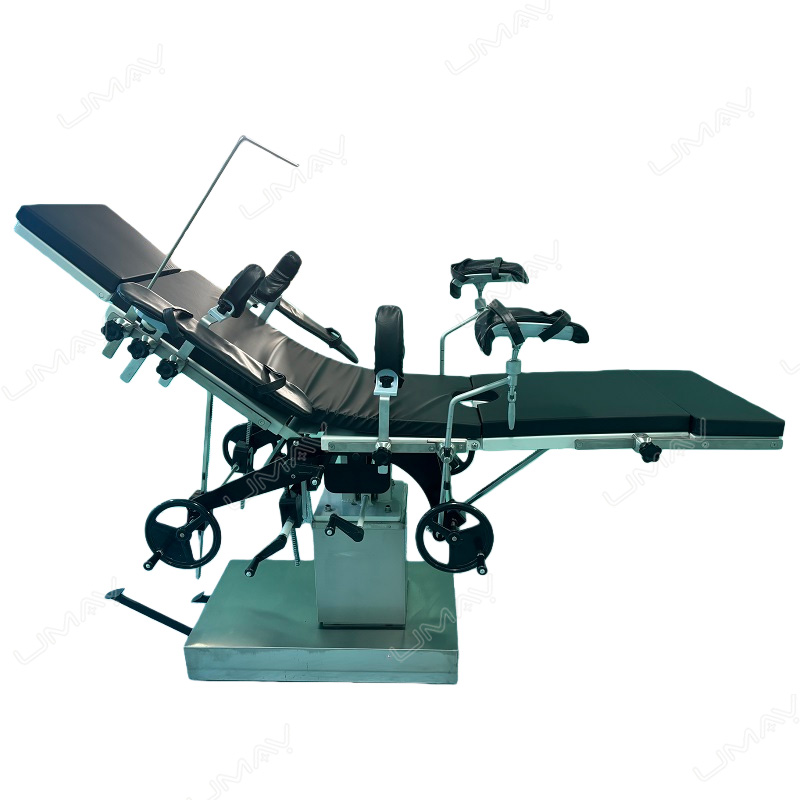
UMETOC013 Mechanical Operating Table
This model uses foot-operated hydraulic height adjustment and manual positioning, including table tilt and adjustable head, back and leg sections. Buyers should compare the available movement range, patient load requirements, mattress and positioning accessories with the planned procedures.
For ceiling-mounted illumination, the UMY-SE-117 Single-Head LED Surgical Light is one catalog option. Where ceiling mounting is unsuitable, the UMY-SE-114 Wall-Mounted or Mobile Surgical Light offers another mounting approach. Buyers can compare further arrangements in the surgical lights category. Confirm mounting points, arm reach, electrical installation and the lighting requirements of the planned procedures before selection.
Anesthesia and Patient Monitoring

UMHA004 Advanced Electronic Flowmeter Anesthesia Machine
The UMHA004 is a human-use anesthesia system with electronic flowmeters, a color touch screen and adult/pediatric operation features. Buyers should review breathing-system specifications, vaporizer configuration, alarm functions, medical gas requirements and the scope of supplied accessories with the anesthesia team.
The UMPM020 Multiparameter Patient Monitor is a separate monitoring option with ECG, SpO2, NIBP, respiration and temperature functions; EtCO2 and invasive blood-pressure options are listed separately. For procedures where the anesthesia team requires EEG-based depth-of-anesthesia assessment, the UMPM024 Anesthesia Depth Monitor may be considered as an additional device. It does not replace the required physiologic monitoring package, which must be approved by the clinical team.
Electrosurgery, Suction and Infusion
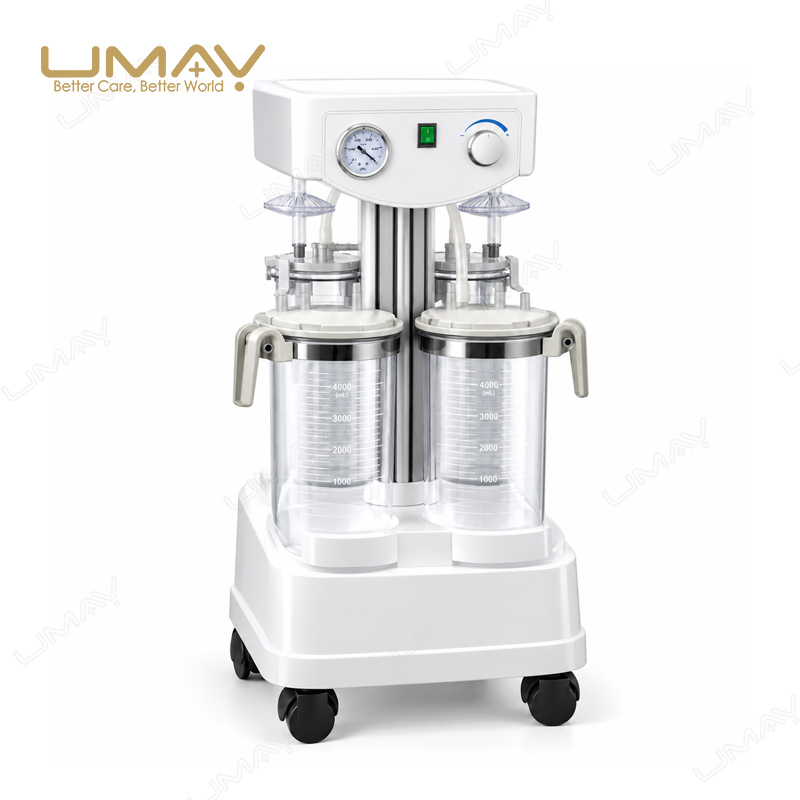
UMH-980D Electric Suction Apparatus
This model is designed for surgical fluid aspiration and uses an oil-less double-piston pump with collection containers and overflow protection. For the RFQ, specify whether suction is needed as the primary source or as backup to an existing wall system. Hospitals comparing portable suction arrangements can also review the UMESM001 Electric Suction Unit with Dual 2500 mL Reservoirs.
For electrosurgery, the UMY-HE-012 400W Electrosurgical Generator is a catalog option featuring monopolar and bipolar modes. Confirm accessory sets, patient return electrodes, procedure compatibility and local technical requirements before selection.
For infusion support, UMY lists the UMH-V5 Infusion Pump and UMSP007 Syringe Pump. Their required quantities depend on actual anesthesia and perioperative therapies, not simply the number of operating tables.
Emergency and Specialty Equipment
The UMH-8000D Defibrillator Monitor can be evaluated for the facility’s resuscitation inventory. For orthopedic and other image-guided procedures, the UMARM043 Mobile C-Arm X-Ray System is a possible specialty imaging option. Neither device should be added to a room package solely because it appears on a general equipment checklist.
For anesthesia teams reviewing airway-management equipment, the LMVOGSP001 Video Laryngoscope is a separate option for visualization during intubation. Include it only where the clinical airway plan calls for a video laryngoscope.
Hospitals also procuring equipment for therapeutic endoscopy can evaluate the UMCM-350Ar Argon Plasma Electrosurgical Unit. Its specialized endoscopic applications should be assessed separately from the general operating-room electrosurgical generator.
5. Purchasing Checks Before Selecting a Model
A quotation that lists only equipment names and unit prices is difficult to compare. For hospital tenders and expansion projects, specifications and included accessories can affect the final cost as much as the main equipment.
- Operating tables: request the load rating, full positioning range, usable tabletop dimensions, mattress, rails and accessories. If fluoroscopy is planned, verify radiolucency and C-arm access rather than assuming a standard table is suitable.
- Surgical lights: confirm mounting style, ceiling height and structural support, lamp-head quantity, working field, arm range and relevant illumination specifications.
- Anesthesia machines: compare gas supply requirements, breathing modes, patient groups, vaporizers, absorber configuration, alarms, battery/backup provisions and staff training requirements.
- Monitoring: specify required clinical parameters and patient categories; check sensors, cuffs, cables, alarm capability and PACU requirements.
- Electrosurgery and suction: check compatible handpieces, patient return electrodes, jars, tubing, filters, replacement parts and cleaning arrangements.
- Installation and service: request dimensions, room drawings, power standards, installation scope, technical documents, training, spare parts and maintenance support.
Include the operating-room infrastructure in the project review: medical gases, electrical power, backup systems, ventilation and infection-control arrangements, equipment movement routes, waste handling, and sterile instrument reprocessing. These items may involve separate contractors and are not included automatically with a UMY equipment quotation.
6. What to Send When Requesting an Operating Room Quotation
A short project brief helps the sales and engineering teams propose the correct configuration instead of quoting a generic collection of devices. The following information is especially useful for hospitals, surgical centers and equipment distributors.
| RFQ field | What to provide |
|---|---|
| Facility and location | Hospital or surgical center, destination country and destination city |
| Room count and case mix | Number of theatres and expected procedures in each room |
| Equipment quantities | Separate required counts for tables, lights, anesthesia, monitoring, electrosurgery, suction and pumps |
| Installation details | Room dimensions, ceiling height/structure, power standard, existing medical gas and suction supply |
| Accessories and clinical options | Table attachments, patient groups, monitors, instrument sets, light-head configurations and specialty equipment |
| Regulatory and tender documents | Country-specific registration, applicable certificates, manuals and tender specification documents |
| Quotation terms | Preferred EXW, FOB or other Incoterm; shipping destination, timeline and installation/training scope |
Ask for an itemized quotation showing each model, included accessories, options, consumables, packing details, warranty terms and service scope. This makes it easier to compare tenders and prevents the equipment budget from excluding necessary accessories.
7. Frequently Asked Questions
Does every operating room need a dedicated anesthesia machine?
That depends on the procedure and anesthetic technique. Rooms offering general anesthesia typically need a suitable workstation and monitoring arrangement available for each active case. Sedation and minor-procedure areas may have different requirements. The anesthesia department should approve the final configuration.
Is a single-head surgical light enough for a general operating room?
Not always. The answer depends on procedure complexity, illuminated field, staff positions and room layout. Compare single- and dual-head configurations with the surgical team before fixing the ceiling mounting plan.
Should a C-arm be included in every operating room package?
No. Mobile fluoroscopy is relevant only to procedures requiring image guidance. The hospital may use a shared unit where scheduling, safety and clinical access permit.
How should we estimate equipment quantities for two or more rooms?
Start with the number of rooms that may be used simultaneously and the procedures performed. Calculate room-dedicated equipment first, then identify shared emergency, imaging, sterilization and recovery resources. Do not use one blanket quantity rule for every device.
Can UMY Medical provide a combined quotation for multiple surgical products?
Buyers can submit a consolidated equipment list with quantities, preferred models and project specifications. UMY Medical can review applicable catalog options and provide an itemized quotation for the requested configuration.
Request an Operating Room Equipment Quotation
Send your room count, planned surgical specialties, equipment quantities, destination country and any technical or tender requirements. UMY Medical can review the relevant operating tables, lights, anesthesia equipment, monitors, electrosurgical units, suction and infusion options.
Clinical planning references: WHO Surgical Safety Checklist and The Joint Commission: Operating Room Equipment Availability. These resources inform equipment planning but do not endorse products or replace applicable local requirements.