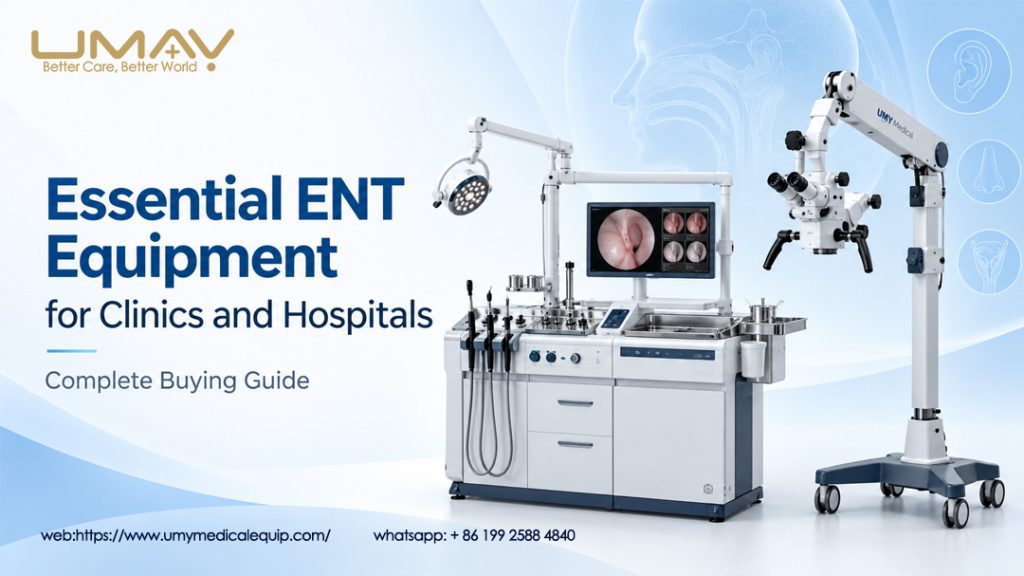
Equipping an ear, nose and throat (ENT) clinic is not simply a matter of purchasing an examination chair and a treatment console. A practical setup must match the procedures performed, the clinician’s preferred visualization method, the room layout and the equipment already in use.
Quick answer
What equipment does an ENT clinic need? A typical ENT examination room may require an ENT treatment unit, adjustable examination chair, examination light, suction and instrument storage. Depending on clinical services, buyers may also need rigid or flexible endoscopes, a camera and light-source system, an operating microscope and imaging accessories. These items are not necessarily included in one package; compare the exact configuration before requesting a quotation.
1. Essential ENT Equipment: What Each Device Does
ENT departments use different combinations of devices for routine examinations, endoscopic visualization and microscope-assisted procedures. The following table separates core workstation equipment from optional clinical systems.
| Equipment category | Primary role | Key buying questions |
|---|---|---|
| ENT treatment unit / workstation | Organizes suction, spray, illumination and instruments for outpatient workflows. | Which functions and accessories are built in? What voltage and room connections are required? |
| ENT examination chair | Positions the patient during consultation and selected procedures. | Does it provide sufficient height, recline, rotation and head support? |
| Rigid or flexible ENT endoscopes | Provide direct visualization of selected ear, nasal, pharyngeal or laryngeal structures. | Which scope type, diameter, length and viewing direction suit the intended examination? |
| Camera, video processor and light source | Display, document or record endoscopic images where configured. | Are the camera coupler, light cable, signal output and existing monitor compatible? |
| ENT operating microscope | Provides magnified illumination for otology and other microscope-assisted workflows. | What magnification, working distance, mounting method and imaging options are required? |
| Instruments, storage and accessories | Support instrument handling, organization and reprocessing workflows. | Which accessories are reusable, disposable, included or purchased separately? |
Explore the complete UMY Medical ENT Equipment category to review available product directions. Final equipment selection should be based on verified model specifications and the intended clinical use.
2. Compare Three ENT Room Configurations
A first-time buyer may receive very different quotations for what is described as a “complete ENT clinic.” Defining the room’s purpose before choosing a package makes offers easier to compare.
| Room type | Usually prioritized | Potential additions |
|---|---|---|
| General ENT consultation room | Examination chair, treatment workstation, focused lighting, basic instruments and accessible storage. | Simple diagnostic optics, instrument trolley or additional suction accessories. |
| Endoscopy-enabled ENT room | Core examination setup plus appropriate endoscopes and a matched visualization system. | Camera head, processor, light source, display, recording and compatible connectors. |
| Microscope-assisted ENT room | Core examination setup plus an ENT-suitable microscope and appropriate patient positioning. | Camera adapter, monitor, assistant viewing, instrument storage and procedural accessories. |
3. Choosing an ENT Treatment Unit and Examination Chair
ENT treatment unit: check functions and standard accessories
The workstation acts as the central equipment hub in many ENT rooms. Compare the suction and spray systems, examination lighting, instrument preparation, work surfaces, storage and how closely the accessories can be positioned to the clinician.
For a concrete example, the UMENT001 ENT Treatment Unit lists adjustable spray/blowing pressure of 0–0.15 MPa, working suction pressure of 0–0.07 MPa, an examination spotlight rated at at least 10,000 lux, a defogging device and three spray guns. The published power supply is AC 220 V ±22 V, 50 Hz ±1 Hz. These are model-specific published specifications, not standards for every ENT workstation.
If you are comparing multiple treatment units, request a standard-accessory list and identify anything offered as an optional upgrade. See the ENT Treatment Units category for available configurations.
ENT examination chair: match patient positioning to the procedure
Chair selection affects clinician access and room ergonomics. Review the adjustment method, seat height range, backrest recline, headrest support, rotation, patient load requirements and the space needed around the chair. A treatment unit and a patient chair may be quoted as separate products.
Review the ENT Examination Chairs category for intended product types, and request exact chair-model specifications before ordering.
4. Selecting ENT Endoscopes and Camera Systems
Endoscopy equipment needs closer compatibility review than its appearance may suggest. A scope, camera, processor and light source are separate elements unless explicitly supplied as a matched system.
Rigid versus flexible endoscopes
Rigid ENT endoscopes are often considered where a stable straight optical design and a defined viewing angle are needed. Flexible ENT endoscopes are useful when access through curved anatomical pathways is required. The clinical team should confirm the anatomy, patient group, diameter, working length, viewing direction and any instrument-channel requirements.
Check the imaging chain before purchase
- Mechanical coupling: the scope eyepiece, camera coupler and any adapters must physically match.
- Illumination: confirm the light-source type, cable interface and required connector.
- Video integration: check processor and camera-head compatibility, video outputs and the monitor’s supported inputs.
- Documentation: specify whether image capture, recording or transfer is actually required.
- Reprocessing: confirm manufacturer-validated cleaning, disinfection or sterilization instructions for each reusable component.
UMY has an ENT Endoscopes category as well as an Endoscopes catalog. A listed endoscope camera system mentions ENT among its possible applications; compatibility with a specific scope must still be confirmed rather than assumed.
5. When Does an ENT Clinic Need an Operating Microscope?
Microscopes are considered when the workflow calls for stable magnification, focused illumination and controlled positioning. They are not interchangeable with a standard examination lamp or a video endoscope. Compare magnification steps, objective working distance, optical head movement, stand design and any required camera or teaching attachments.
As one current UMY example, the floor-standing surgical microscope (currently listed as UMH-ZC01) specifies 4×, 6×, 10×, 16× and 25× magnification options, an LED light source and a variable objective range of 200–350 mm. The appropriate configuration and ENT application should be reconfirmed for the intended clinical procedures.
See also ENT Microscopes and the broader Surgical Microscope category.
6. Plan the ENT Room Before Approving the Equipment List
Even suitable individual devices can create a poor setup when they are arranged without considering the actual clinical workflow. Ask the project team to review:
- Room dimensions and access: chair movement, workstation reach, operator position, door clearance and maintenance access.
- Electrical supply: destination-country voltage, frequency, plugs, grounding and the electrical specifications of every selected component.
- Utility requirements: whether the chosen equipment needs its own suction, compressed air, water, drainage or other connections.
- Display and cable placement: monitor visibility, camera location, cable routing and safe separation from movement paths.
- Infection prevention: appropriate instrument storage and reprocessing arrangements consistent with manufacturer instructions and local clinical protocols.
- Serviceability: access to pumps, containers, lamps, tubing, consumables and replacement parts.
Do not assume installation services, all accessories or local regulatory documentation are included just because a quotation refers to a “complete ENT system.” Request confirmation in writing.
7. ENT Equipment Procurement Checklist for Hospitals and Distributors
A detailed RFQ improves the quality of supplier comparisons and reduces misunderstandings about model options and bundled accessories.
- Facility and destination: hospital/clinic type, destination country and number of rooms.
- Clinical scope: routine ENT consultations, endoscopic examinations, microscope-assisted procedures or a combination.
- Equipment list: treatment units, chairs, endoscopes, camera systems, microscopes and required accessories.
- Technical requirements: room dimensions, voltage/frequency, optical specifications and available utility connections.
- Existing equipment: brands/models of any scopes, light sources, processors, monitors or attachments to be reused.
- Scope of supply: standard items, optional accessories, spare parts, consumables and maintenance materials.
- Documentation: instructions for use, manufacturer specifications, applicable regulatory documents and product identification.
- Commercial terms: quantity, delivery destination, packing requirements, installation/training needs and requested quotation terms.
For multi-room hospital projects, it can be helpful to submit a room-by-room equipment list rather than a single undifferentiated product request.
8. Common Procurement Mistakes
Comparing incomplete quotations
A low workstation price may exclude the chair, scopes, imaging system or essential accessories. Compare like-for-like configurations.
Assuming optical compatibility
Scope eyepieces, couplers, processors and light-source connectors vary. Request compatibility review using exact model information.
Ordering before checking the room
Confirm usable space, electrical supply, operator access and utility requirements before accepting a configuration.
Overlooking service and reprocessing
Ask about spare accessories, replacement parts, equipment manuals and validated reprocessing instructions where applicable.
Frequently Asked Questions About ENT Equipment
What is included in a complete ENT examination room?
It depends on the clinical workflow. A basic room may include a treatment workstation, examination chair, light, diagnostic instruments and storage. Endoscopy or microscope-assisted rooms may require additional optical equipment, cameras, processors, monitors and accessories. Ask for an itemized equipment schedule.
Is an ENT treatment unit the same as an ENT examination chair?
No. The treatment unit generally organizes equipment functions such as suction, spray, lighting and instrument access. The examination chair positions the patient. They should be specified and priced separately unless the supplier clearly confirms a combined package.
Can new ENT endoscopes work with an existing camera system?
Sometimes, but compatibility is not universal. The scope eyepiece, coupler, light-guide connector, camera head and processor need to be checked against the existing system. Send exact model numbers and interface photographs for review.
Which ENT equipment should a small clinic buy first?
Start with the clinician’s planned services and essential examination workflow rather than a predefined package. An appropriately configured treatment workstation, chair, illumination and basic instruments may be a starting point; endoscopy or microscopy should be selected when justified by the intended clinical work.
What should an international distributor include in an ENT equipment RFQ?
Provide the destination country, quantities, room layout, required product categories, preferred specifications, local electrical standard, existing equipment that must interoperate and any required documents or service arrangements.
Planning an ENT Clinic or Hospital Equipment Purchase?
Send UMY Medical your ENT equipment list, room requirements and intended clinical applications. We can review available model options, requested configurations and quotation details for your project.
Equipment availability, clinical indications, technical specifications, compatibility, accessories and applicable regulatory requirements depend on the specific model and destination market. Confirm these details before ordering.