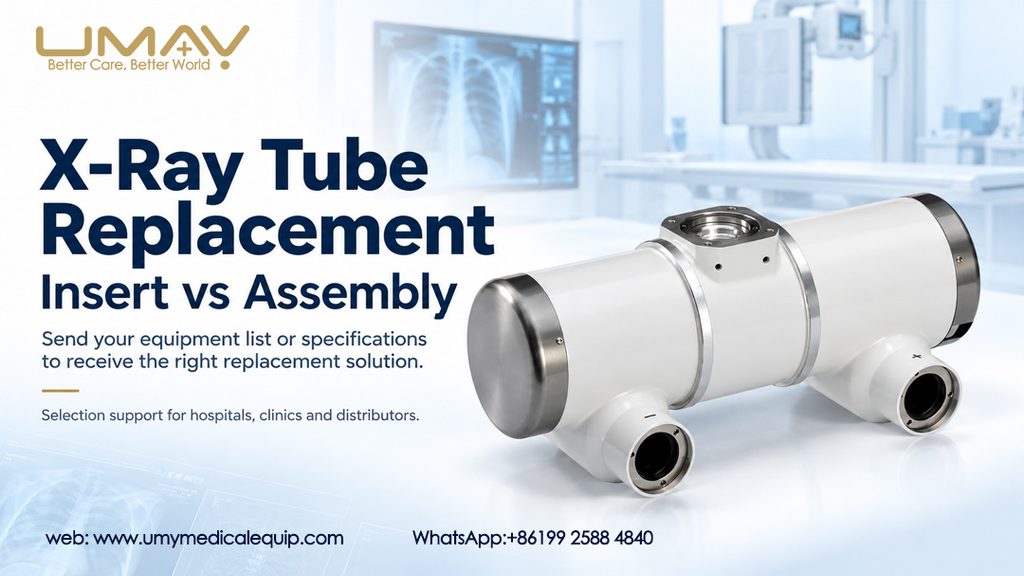
Replacing an X-ray tube in a digital radiography (DR) system? The first purchasing decision is whether you need an X-ray tube insert or a complete X-ray tube assembly. Selecting a replacement by tube voltage alone can lead to installation, generator-interface or thermal-loading problems.
This guide helps hospital maintenance departments, biomedical engineers, imaging service providers and medical equipment distributors identify the required component, compare published specifications and prepare an accurate replacement enquiry.
An X-ray tube insert is the internal X-ray-generating component. An X-ray tube assembly is the housed unit incorporating the insert and other features required by its design. Before ordering, confirm the existing tube and housing models, generator, high-voltage connections, stator, mounting geometry and cooling requirements.
X-Ray Tube Insert vs Assembly: What Is the Difference?
A rotating-anode X-ray tube insert typically includes the evacuated envelope, cathode and rotating-anode components. By contrast, the complete assembly incorporates the insert in a protective housing with the relevant electrical insulation, radiation shielding and cooling arrangement.
| Buying consideration | Tube insert | Tube assembly |
|---|---|---|
| What is supplied? | Internal X-ray-producing component | Housed X-ray tube product |
| Protective housing | Not normally included | Included as part of the assembly |
| Main compatibility question | Does the insert match the existing housing and service procedure? | Does the assembly match the complete X-ray system? |
| Procurement information | Insert model, housing reference and qualified service requirements | Complete tube model, generator, HV connectors, stator, cooling and mounts |
| Installation | Requires specialist tube-housing service | Requires qualified system-level replacement and testing |
Important: Supplier listings sometimes use the words “insert” and “assembly” loosely. Request a clear scope of supply, preferably supported by the product nameplate and technical drawing, before placing an order.
Seven Specifications to Check Before Replacing an X-Ray Tube
1. Original tube and equipment models
Record the existing X-ray tube model, housing designation, X-ray machine manufacturer and exact system model. If available, provide photographs of the identification label and the installed assembly. A reference model is a starting point for technical comparison, not proof of interchangeability.
2. Maximum tube voltage and generator ratings
Published maximum ratings such as 125 kV or 150 kV describe only part of the electrical specification. Confirm the generator’s voltage range, tube loading and protection functions. A higher maximum voltage does not automatically make one tube compatible with a lower-rated system.
3. Small and large focal spots
Common dual-focus configurations include 1.0/2.0 mm and 0.6/1.2 mm. Focal-spot selection affects the balance between geometric sharpness and allowable loading. It must be reviewed together with the generator and the relevant exposure ratings.
4. Anode and housing thermal ratings
Check anode heat content, complete assembly heat content, cooling curves and the intended examination workload. Do not confuse anode heat capacity with housing heat capacity; they are different measurements and cannot be compared as if they were the same.
5. High-voltage connectors, filament and stator
Verify HV receptacle type, grounding, filament requirements, anode rotation and stator electrical specifications. These details may prevent installation even when voltage and focal-spot figures look similar.
6. Physical dimensions and mounting
Confirm housing dimensions, mounting positions, X-ray port orientation, electrical cable clearance and mechanical alignment. A replacement must fit the existing system geometry as well as its electrical configuration.
7. Cooling method, documentation and safety
Review natural or forced-air cooling requirements, manufacturer loading charts, service instructions and relevant radiation-protection requirements. Replacement and acceptance testing must be carried out by qualified personnel using the equipment manufacturer’s procedures.
UMY Medical Rotating-Anode Tube Assembly Examples
UMY Medical lists the following complete X-ray tube assemblies for diagnostic radiography enquiries. They illustrate specification differences; they are not presented as interchangeable replacements.
| Published specification | UMY-XM-075 | UMXRAY080 (LQ16-XD57) |
|---|---|---|
| Product type | Rotating-anode tube assembly | Rotating-anode tube assembly |
| Maximum radiographic tube voltage | 125 kV | 150 kV |
| Nominal focal spots | 1.0 / 2.0 mm | 0.6 / 1.2 mm |
| 0.1-second anode input at 50 Hz | 20 / 40 kW (small / large) | 20 / 50 kW (small / large) |
| Anode heat content | 150 kHU | 300 kHU |
| Complete assembly heat content | 1410 kHU | 1410 kHU |
| Product details | View UMY-XM-075 | View UMXRAY080 |
Figures are taken from the current UMY Medical product specifications. Final configurations and component identification must be checked against the actual product documentation before quotation or installation.
UMY-XM-075: 125 kV Assembly
The UMY-XM-075 rotating-anode X-ray tube assembly is listed with 1.0/2.0 mm nominal focal spots and a 150 kHU anode heat-content rating. Its product page uses Canon E7239X as a comparison reference; buyers should not interpret this as a blanket compatibility guarantee.
UMXRAY080: 150 kV Assembly
The UMXRAY080 / LQ16-XD57-20.50/150 is explicitly listed as a housed assembly, not an un-housed insert. Its published specification includes 0.6/1.2 mm focal spots and 300 kHU anode heat content. References to Canon E7876X or Varex RAD-12 are for replacement research and technical comparison only; direct compatibility must be confirmed separately.
Are CT X-Ray Tubes Interchangeable with DR Tubes?
No general interchangeability should be assumed. CT tube designs have different thermal, mechanical, rotational and system-integration requirements. For example, UMY Medical separately lists the XRT02 X-ray tube for CT scanners, with a nominal tube voltage of 140 kV and specifications intended for CT applications. Its voltage rating alone cannot qualify it for a conventional DR system.
Why a Complete DR System Configuration Matters
A DR system combines a high-voltage generator, X-ray tube, detector, positioning structure and control software. The UMDRXY006 digital X-ray system, for example, offers several generator configurations and distinguishes lower- and higher-power tube arrangements. The correct replacement depends on the equipment actually supplied and installed, not the DR model name alone.
X-Ray Tube Replacement Procurement Checklist
Before asking a supplier to recommend a replacement, prepare the following information. It helps reduce avoidable back-and-forth and supports a more accurate technical review.
Existing tube and housing model, X-ray machine model and clear nameplate photographs.
Generator model, rated kV, focal spots, HV connector and stator information.
Mounting photos/dimensions, port orientation, cooling arrangement and workload.
Quantity, destination country, expected delivery schedule and required documentation.
If the technical data is incomplete, start with the equipment and tube labels plus photographs. The supplier should identify any further information required before making a replacement recommendation.
Frequently Asked Questions
Is an X-ray tube insert the same as an X-ray tube assembly?
No. The insert is the internal X-ray-generating component. The complete assembly includes the relevant housing and associated provisions defined by the manufacturer.
Can a 150 kV tube replace a 125 kV tube?
Not based on voltage alone. Electrical interfaces, focal spots, heat loading, cooling, mounting and generator compatibility must all be verified.
What should I send for an X-ray tube replacement quote?
Send the existing tube/housing model, complete equipment model, nameplate photographs, generator details, quantity and destination country. Mounting and connector images are also helpful.
Does a cross-reference mean a replacement is guaranteed to fit?
No. Cross-references assist identification and comparison. They do not establish manufacturer authorization or guaranteed compatibility. Final suitability requires a system-specific technical review.
Request an X-Ray Tube Replacement Review
Have a tube replacement list or a model you need to source? Send UMY Medical the existing tube model, equipment model, nameplate photo, quantity and destination. We can review the published options and discuss the information needed for a suitable quotation.
For quotation and technical identification only. Installation and radiation-safety verification must be performed by qualified professionals.