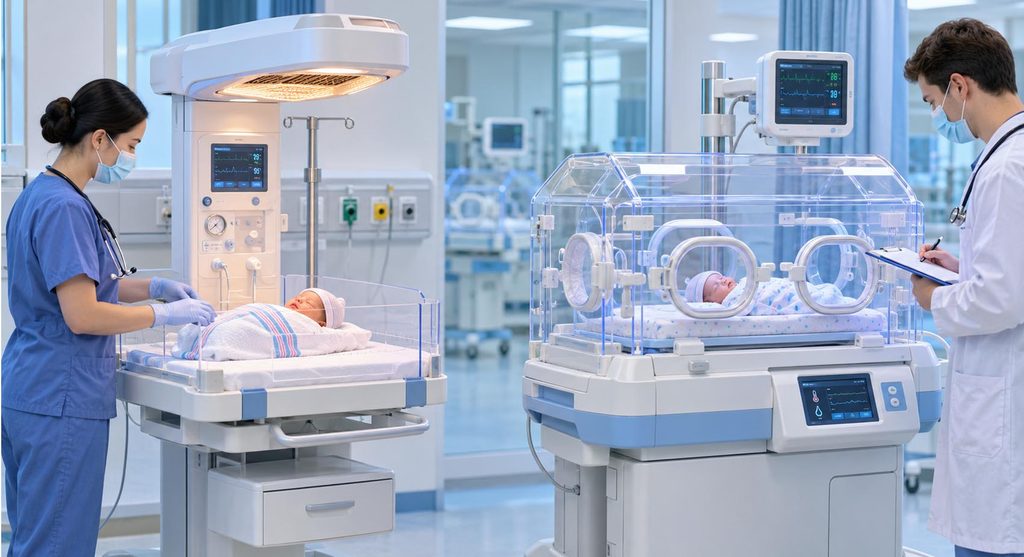
When a hospital plans a delivery room or neonatal care unit, the equipment list often includes both a baby radiant warmer and an infant incubator. They share an important purpose—supporting newborn temperature management—but they are not interchangeable. A radiant warmer is an open-care system that prioritizes rapid access to the baby. An incubator creates an enclosed, heated environment that can be better suited to ongoing care for some premature or temperature-sensitive newborns.
The right equipment depends on the care setting. Delivery rooms need rapid access to the newborn, while neonatal units may require prolonged control of temperature and humidity. This guide compares how both devices work, the clinical settings they serve, and the specifications to include in a purchase request.
What Is a Baby Radiant Warmer?
A baby radiant warmer—also called an infant radiant warmer or neonatal radiant warmer—typically combines an open infant bed with an overhead heat source. Because there is no fixed enclosure around the infant, clinicians can reach the baby directly for assessment, monitoring and selected procedures.
Radiant warmers are often considered for delivery rooms, newborn stabilization areas and procedures where easy access matters. Depending on the model, features may include servo temperature control, a skin-temperature probe, adjustable bed tilt, an examination light, alarms and an X-ray cassette tray. The open design also means that room conditions can influence heat loss, so temperature monitoring and local neonatal protocols remain essential.
The UMIRW003 radiant warmer provides servo temperature control, adjustable bed tilt and an examination light. It is part of our infant radiant warmer range.
What Is an Infant Incubator?
An infant incubator uses a protective enclosure, or hood, to establish a controlled thermal environment for neonatal care. Staff usually access the baby through designated access ports or doors. Depending on the configuration, an incubator may regulate air temperature, respond to a skin-temperature sensor, or provide additional environmental features such as humidity management.
The enclosed environment can be particularly relevant when a neonatal team requires sustained thermal support for a premature or low-birth-weight infant. Advanced models may also combine temperature control with humidity regulation, oxygen concentration control, SpO2 monitoring or weighing. These functions vary by model.
For example, the UMIFIB004 focuses on air-servo temperature control, while the UMIFIB005 combines thermal care with integrated monitoring functions.
Baby Warmer vs Infant Incubator: Comparison at a Glance
| Buying Factor | Radiant Warmer | Infant Incubator |
|---|---|---|
| Care design | Open infant bed with overhead warming | Enclosed heated compartment |
| Access to newborn | Direct and continuous access for staff | Access through ports or doors; frequent opening may disturb the environment |
| Temperature management | Radiant heat; manual or servo modes depending on model | Controlled enclosure temperature; air and/or skin modes depending on model |
| Humidity control | Not typically an enclosed humidity-controlled environment | Available on selected models; compare humidity-control range |
| Common purchasing context | Delivery room, stabilization and frequent-access procedures | NICU or neonatal unit requiring ongoing enclosed thermal support |
| Key specifications | Heater, skin probe, alarm system, mattress, bed tilt and accessories | Air/skin control, hood access, humidity, alarms, mattress and monitoring options |
The comparison describes equipment design and procurement considerations; neonatal care teams select the appropriate warming method for each patient.
Which Equipment Is Better for a Delivery Room?
For newborn assessment and resuscitation workflows, open access is a major practical consideration. A radiant warmer allows clinical staff to monitor the infant and reach the airway or chest without repeatedly opening an enclosure. That makes radiant warmers a common part of delivery-room equipment planning.
Not every newborn needs a radiant warmer. Skin-to-skin care is appropriate for many stable newborns, while clinical teams use additional warming when indicated by the infant’s condition and local neonatal protocols.
Which Equipment Is Better for Ongoing NICU Care?
For some premature or low-birth-weight infants, a controlled enclosed environment may be more appropriate for ongoing temperature support. The incubator’s hood helps maintain the intended thermal environment and, in suitable configurations, may allow humidity control. This is one reason neonatal units commonly plan incubator capacity separately from delivery-room warmer capacity.
However, an incubator is not automatically the right choice for every intervention. Frequent procedures and bedside interventions may instead favor an open-care system or a different thermal-care arrangement. Equipment planning should reflect the unit’s usual patient needs and procedures.
Seven Questions to Ask Before Buying Neonatal Warming Equipment
1. Which department will use the equipment?
Separate delivery-room, neonatal observation, NICU and procedure-room requirements. A unit selected for immediate newborn assessment may need different access and mobility features from one intended for longer-term controlled warming.
2. Is skin-temperature servo control required?
Compare the available control modes—manual, air-temperature and skin-servo—and the supplied temperature probes. Servo control also requires correct sensor placement and routine monitoring during use.
3. What environmental functions are needed?
For incubators, specify whether adjustable humidity is required and request its operating range. Additional environmental controls, such as oxygen concentration regulation, are model-specific.
4. What alarms and monitoring features are included?
Compare temperature displays, audible and visual alarms, and probe-disconnection alerts. For integrated monitoring, check the availability of SpO2, pulse-rate measurement and weighing against the department’s equipment list.
5. How easily can staff access and clean the equipment?
Compare hood access ports, mattress handling, bed adjustments and removable parts. Include the operating manual, cleaning instructions and preventive-maintenance schedule in the purchasing documents.
6. What are the room and power requirements?
Include unit dimensions, floor space, cable routing, voltage, plug type and backup-power arrangements in the site requirements. These details become especially important when outfitting several rooms or an entire neonatal department.
7. What should be included in the supplier quotation?
An itemized quotation should state the main unit model, temperature probes, mattress, hood or bed accessories, monitoring options, warranty, training and service terms. Specify the quantity, destination country and electrical requirements.
Compare Selected UMY Medical Models
UMY Medical offers radiant warmers and infant incubators for different neonatal-care settings. The models below illustrate how access, temperature control and integrated functions differ.
UMIRW003 — Infant Radiant Warmer with Servo Temperature Control
The UMIRW003 is an open-care infant radiant warmer with skin-temperature monitoring, servo temperature control, an adjustable bed, examination lighting and an integrated X-ray cassette tray. Its design is relevant to delivery-room and newborn-access workflows.
UMIFIB004 — Neonatal Incubator with Air-Servo Control
The UMIFIB004 provides a transparent incubator enclosure with air-servo temperature control and access ports. Its enclosed design suits procurement specifications focused on air-controlled neonatal warming.
UMIFIB002 — Incubator with Air and Skin Servo Control
The UMIFIB002 adds air- and skin-temperature servo modes, alarm indications and multiple access ports. It is suited to equipment lists that require both air- and skin-servo temperature modes.
UMIFIB005 — Incubator with Touchscreen and Integrated Monitoring
The UMIFIB005 features a color touchscreen, air- and skin-temperature control, humidity and oxygen concentration controls, and integrated SpO2, pulse-rate and weight monitoring. Include the required sensors and accessories as individual items in the purchase quotation.
Planning a Neonatal Department: Buy for the Workflow, Not Just the Unit Price
A project purchasing multiple devices should map the newborn’s pathway from delivery to observation and, when necessary, neonatal intensive care. Determine how many care stations require immediate open access and how many need ongoing enclosed thermal support. Include staff training, cleaning capacity, maintenance, compatible monitoring equipment and replacement sensors in the procurement plan.
When requesting offers from multiple suppliers, use the same specifications for power supply, temperature-control modes, supplied sensors, monitoring options and warranty. That makes price comparisons meaningful across different markets.
Frequently Asked Questions
Is a radiant warmer the same as an infant incubator?
No. A radiant warmer provides overhead heating in an open-care design, while an infant incubator creates a controlled enclosed environment. Each serves different care and workflow requirements.
Can a baby warmer replace an incubator in a NICU?
Not in every situation. An open warmer may be preferable when frequent access is needed; an incubator can be more suitable for ongoing environmental support for selected infants. Clinical teams determine which device and combination of thermal-care measures are appropriate.
Do all incubators have humidity and SpO2 monitoring?
No. Humidity control and SpO2 monitoring are model-dependent. A quotation should distinguish built-in functions from optional modules and separately supplied accessories.
What details should a distributor provide when requesting a quote?
Share the destination country, quantity, intended department, warmer or incubator requirement, desired temperature-control modes, monitoring options, power supply and delivery timeline.
Request a Baby Warmer or Infant Incubator Quotation
Planning a delivery room, maternity ward or neonatal unit? Send UMY Medical your equipment list, required quantities, target use and destination country. We can prepare a model-by-model quotation with the requested temperature-control features, accessories and shipping destination.
UMY Medical also supplies pediatric and neonatal equipment for hospital departments.
Clinical References
Clinical background references include the Royal Children’s Hospital thermoregulation guidance and American Heart Association neonatal resuscitation guidance. Clinical teams should use these devices according to the operating instructions and their neonatal-care protocols.