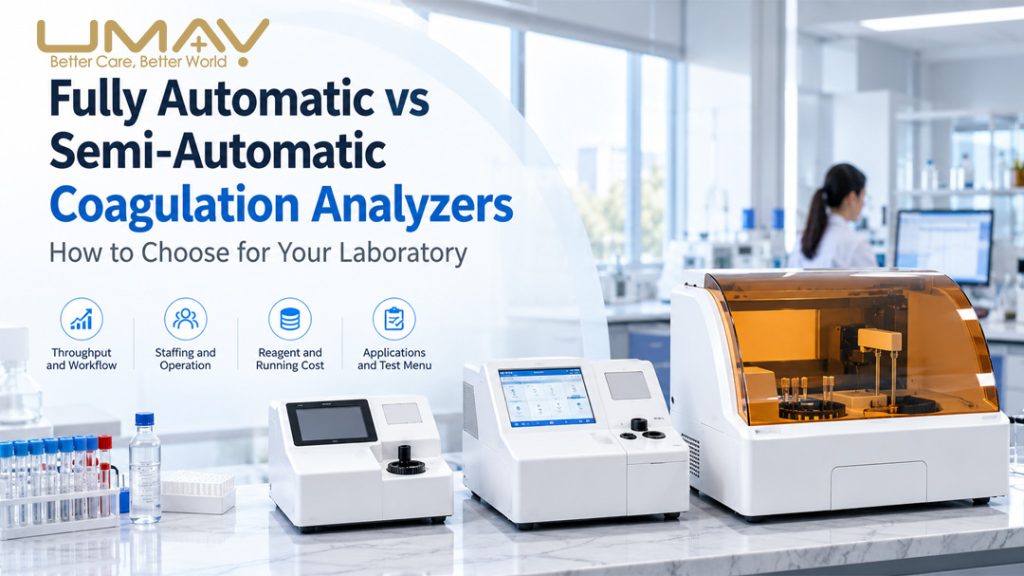
Choosing between a semi-automatic and a fully automatic coagulation analyzer is primarily a workflow decision. Both can support routine coagulation testing, but they differ in how samples and reagents are handled, how much staff time is required and what a laboratory must budget for ongoing operation.
For hospitals, diagnostic laboratories and distributors, the starting point is the required test menu and daily workload. A low-volume laboratory may be well served by a semi-automatic unit. Where testing is frequent or staff need to process many requests in succession, automation becomes more valuable.
How do the two systems differ?
With a semi-automatic analyzer, the operator performs steps such as preparing the reaction and adding samples or reagents. The instrument measures the reaction and processes the result. A fully automatic system automates more of this sequence, including sample and reagent handling, within the limits of its configuration.
| Buying factor | Semi-automatic analyzer | Fully automatic analyzer |
|---|---|---|
| Daily operation | Technician performs more preparation and dispensing steps. | Automates a larger portion of sample and reagent handling. |
| Sample volume | Well suited to workloads that staff can manage manually. | Worth considering for regular testing runs or higher peak demand. |
| Test menu | Depends on the model, method and validated reagents. | Also depends on the model, method and validated reagents. |
| Routine costs | Reagents, reaction cups, controls and pipetting supplies. | Reagents, reaction consumables, controls, calibrators and any cleaning supplies. |
| Workflow planning | Operator technique and staff availability matter. | Requires attention to loading capacity, maintenance and supply continuity. |
Neither type should be selected on automation level alone. A laboratory that runs only a small number of tests can still have strict reporting requirements; a fully automatic instrument may not be necessary to meet them. Equally, a compact semi-automatic system may become time-consuming when the workload grows.
Five questions to settle before choosing a coagulation analyzer
1. Which tests must the laboratory perform?
Start with the routine assay list: PT, APTT, TT and fibrinogen are common requirements. Some laboratories also need D-dimer, fibrin degradation products (FDP), antithrombin III (ATIII) or clotting factor assays.
Do not assume that every analyzer sold as a “coagulation analyzer” can perform every test. Ask the supplier to confirm the test principle, appropriate reagents, controls and calibration procedure for the model being quoted.
2. How many tests are performed each day?
Count tests rather than patient samples. A patient requiring both PT and APTT represents two assay requests. Repeats, quality-control measurements and any additional testing increase the total workload.
Also identify the busiest hour. A laboratory running 60 tests spread across a day has a different workflow from one that receives most samples in a short morning period.
3. How much technician time is available?
A semi-automatic analyzer may fit a laboratory where a technician can prepare samples and handle reactions individually. When the same staff member must also manage other bench instruments, automated sample and reagent handling may be easier to accommodate.
4. What is the real operating cost?
Compare more than the instrument price. Obtain a reagent and consumable list covering reaction vessels, quality controls, calibrators, cleaning materials where applicable, and replacement items. Ask about pack sizes, storage temperature, expiry periods and local supply arrangements.
5. What happens after installation?
Check power requirements, result output, LIS or PC connectivity, service arrangements, user training and the documentation needed at the destination. A good purchase decision should account for the laboratory’s routine work after the equipment is delivered.
Coagulation analyzers in the UMY Medical range
The following models offer different levels of automation. Their test menus and accessories should be confirmed against the intended laboratory workflow rather than treated as interchangeable.
UMALZ006 — Semi-Automatic Coagulation Analyzer
UMALZ006 is a single-channel analyzer using optical light-scattering measurement. It has a 240 × 128 LCD, built-in thermal printer, RS232 connection and memory for up to 10,000 results. The routine test list includes PT, APTT, TT, fibrinogen and clotting factor testing. The PT-derived fibrinogen method and electronically linked pipette are optional.
Relevant for: laboratories planning routine coagulation testing with hands-on sample preparation.
UMALZ033 — Semi-Automatic Coagulation Analyzer
UMALZ033 is a single-channel system with a 7-inch touchscreen and 405/660 nm measurement wavelengths. Its test menu includes PT, APTT, TT, fibrinogen, D-dimer, FDP, ATIII and clotting factor testing, subject to the relevant assay methods and reagents.
Relevant for: laboratories that need a wider specified test menu while retaining a semi-automatic workflow.
UMH-1000C — Fully Automatic Coagulation Analyzer
UMH-1000C is a fully automatic coagulation analyzer rated at 100 tests/hour, with four test channels, six sample positions and eleven reagent positions (8 + 3). It provides reagent refrigeration and LIS connectivity. Supported tests listed for this model include PT, APTT, TT, fibrinogen, D-dimer and FDP.
Relevant for: laboratories seeking automated handling for regular multi-assay workloads. Actual processing time depends on the selected assays and working conditions.
What should a quotation include?
A quotation that names only the instrument model is difficult to compare. Ask each supplier to list the proposed test configuration and the items needed to put the equipment into routine service.
- Equipment: model, number of test channels, included accessories and any optional functions.
- Assays: required test menu, compatible reagents, controls and calibrators.
- Capacity: daily workload, busiest-hour demand and intended reporting turnaround.
- Consumables: reaction cups, pipettes or probes, cleaning supplies and estimated replenishment needs.
- Site requirements: voltage, computer or LIS connection, operator training and installation support.
- Commercial details: destination country, lead time, shipment terms, warranty and service arrangements.
Frequently asked questions
Is a fully automatic coagulation analyzer always more accurate?
No conclusion about analytical accuracy can be drawn from the level of automation alone. Compare the method, assay validation, quality-control performance and specifications for each proposed system.
Can a semi-automatic system perform D-dimer testing?
Some models can. UMALZ033 includes D-dimer in its test menu, but the measurement method and appropriate reagent combination must be confirmed before ordering.
Does a four-channel analyzer perform four times as many tests?
Not necessarily. Total throughput depends on test duration, assay mix, sample handling and instrument design. Channel count is only one part of the workflow.
What information should I send for a quotation?
Share the routine and specialty tests required, estimated tests per day, peak-hour workload, destination country, and any reagent, consumable or LIS requirements.
Request a coagulation analyzer quotation
Send us the assays you need, estimated daily test volume and destination country. We can review the requirements and suggest a suitable UMY Medical configuration, including reagents and consumables for quotation.
More equipment: UMY Medical Coagulation Analyzers