A veterinary CBC machine is often one of the first laboratory purchases considered by a growing animal clinic. The challenge is not simply finding an analyzer that can count blood cells. It is selecting a system with an appropriate white blood cell differential, species settings, reagent supply and reporting workflow for the clinic’s actual workload.
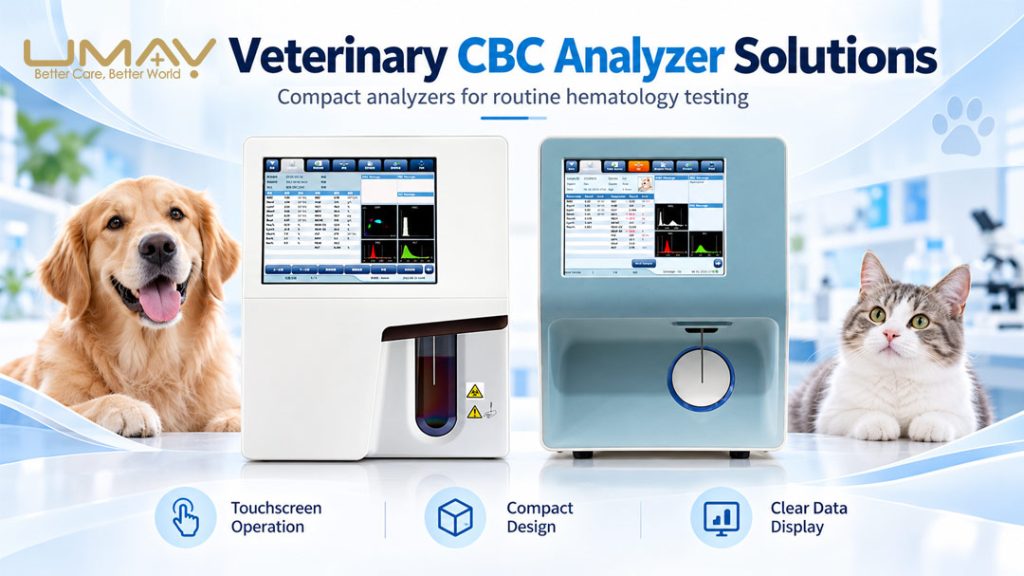
How to compare 3-part and 5-part veterinary hematology analyzers, which questions to ask before ordering, and when a separate veterinary chemistry analyzer is also needed. It uses published specifications from UMY Medical’s BC-20 Vet, BC-5000 Vet and Vetube 30 as practical examples.
What Does a Veterinary CBC Machine Measure?
A complete blood count (CBC) provides information about red blood cells (RBC), white blood cells (WBC), hemoglobin, hematocrit, platelets and related indices. Depending on the analyzer, it can also report different categories of white blood cells. These results support routine veterinary laboratory assessment, but they do not establish a diagnosis on their own.
Species matter. A dog, cat, horse and rabbit should not automatically be evaluated against the same reference intervals. The laboratory should use appropriate species settings and reference intervals, review instrument flags and maintain a process for checking unusual results. Automated differentials do not replace a blood smear review when cell morphology or platelet clumping needs examination.
3-Part vs 5-Part Veterinary Hematology Analyzers
The main purchasing difference is how white blood cells are categorized. A 3-part differential generally groups leukocytes into broader populations such as lymphocytes, mid-sized cells and granulocytes. A 5-part differential provides more detailed categories such as neutrophils, lymphocytes, monocytes, eosinophils and basophils. Actual reporting capabilities and methods vary by model and species.
| Buying consideration | 3-part veterinary CBC analyzer | 5-part veterinary CBC analyzer |
|---|---|---|
| White blood cell differential | Broader cell-group reporting | More detailed WBC category reporting |
| Typical selection rationale | Routine in-house CBC workflow where a 3-part differential meets the clinic’s needs | Clinics and laboratories that require more detailed automated leukocyte differentiation |
| Important limitation | Less detail in automated white blood cell categories | More detail does not eliminate the need to check flags or review blood smears |
| Purchase checks | Species validation, sample volume, throughput, quality control, reagent supply, data connectivity, service and total running cost | |
There is no universal rule that every practice needs a 5-part analyzer. The best configuration depends on the veterinarian’s diagnostic requirements, sample volume, staff expertise and the availability of reference laboratory services.
UMY Medical Product Examples: BC-20 Vet and BC-5000 Vet
The following specifications are drawn from the current published UMY Medical product pages. They are examples for comparison, not a claim that either model fits every clinic.
| Specification | BC-20 Vet | BC-5000 Vet |
|---|---|---|
| Analyzer category | Automated 3-part veterinary hematology analyzer | Automated 5-part veterinary hematology analyzer |
| Whole-blood sample volume | 9 µL | 15 µL |
| Display | 8.4-inch touchscreen | 10.4-inch touchscreen |
| Connectivity described on product page | LAN, HL7 and bidirectional LIS | USB, LAN and bidirectional LIS |
| Published throughput | Confirm against the current supplier datasheet before ordering | Up to 60 samples per hour |
| Product details | BC-20 Vet specifications | BC-5000 Vet specifications |
When reviewing a quotation, ask the supplier to confirm the current configuration sheet, supported animal species, language options, reagent names, quality-control materials and available local technical support.
Seven Questions to Ask Before Buying a Veterinary CBC Machine
1. Which animal species will the laboratory test?
Make a list of your routine species and approximate testing frequency. A clinic handling mainly dogs and cats may have different requirements from a mixed animal practice or livestock laboratory. Check that the analyzer has suitable species-specific modes and locally appropriate reference intervals; a long species list alone does not establish diagnostic validation for every test.
2. How many CBC samples will you process each day?
Estimate the average and peak-day workload, not just the manufacturer’s maximum hourly throughput. Include time for sample collection, mixing, instrument checks, quality control, flagged results and cleaning. A higher nominal throughput is useful only if the surrounding workflow can support it.
3. Do you need a detailed five-part differential?
Ask the veterinary team which WBC categories it uses in routine decision-making. A 3-part analyzer may be a sensible solution for a defined routine workflow. A 5-part analyzer may be appropriate where more granular leukocyte data is required, but flagged or atypical samples may still need smear examination and further review.
4. What are the ongoing reagent and quality-control requirements?
Request a complete list of diluents, lysing reagents, cleaners, calibration materials and controls. Confirm the consumption assumptions used in the quotation, shelf life, storage conditions, shipping restrictions and replenishment lead times for your destination country. Price the expected annual operating cost rather than comparing instrument prices alone.
5. What sample volume and handling requirements apply?
Check the sample type, minimum volume, anticoagulant, collection tubes, mixing procedure and time limits in the manufacturer’s current instructions. For example, UMY Medical publishes a 9 µL whole-blood requirement for BC-20 Vet and 15 µL for BC-5000 Vet. Those figures should not be treated as complete sample collection instructions.
6. Can the results fit into your reporting workflow?
Ask about the supported printer types, result storage, USB/LAN ports, LIS connectivity, barcode requirements and software compatibility. If the clinic needs data exchange with an existing management system, request compatibility confirmation before placing an order instead of assuming that “LIS supported” guarantees a plug-and-play connection.
7. Who will maintain and support the instrument?
For international procurement, clarify installation responsibilities, operator training, preventive maintenance, spare-part availability and remote or on-site troubleshooting. Ask for a written scope of support and the consumables included with the initial delivery.
CBC Analyzer vs Veterinary Chemistry Analyzer: Do You Need Both?
A hematology analyzer and a chemistry analyzer answer different laboratory questions. CBC testing focuses on blood cell counts and related indices. Chemistry testing evaluates biochemical analytes such as enzymes, metabolites, proteins and electrolytes, depending on the panel and configuration. One device should not be presented as a substitute for the other.
UMY Medical’s Vetube 30 Veterinary Dry Chemistry Analyzer is a separate example in the laboratory range. Its published page lists a 100 µL sample volume, a testing time of approximately 10 minutes per sample and various veterinary biochemistry panels. Buyers should verify the exact panel availability, sample requirements and consumable supply for their selected configuration.
Veterinary Laboratory Procurement Checklist
Before requesting a formal quotation, prepare the following information:
- Animal species and average/peak daily CBC test volume.
- Required 3-part or 5-part differential and reporting parameters.
- Sample collection and minimum-volume requirements.
- Reagents, controls, calibration and cleaning consumables needed for the first operating period.
- Expected annual reagent demand and preferred supply schedule.
- Printer, language, barcode and LIS requirements.
- Power supply, installation space and environmental conditions.
- Destination country, quantity, shipping preferences, training and after-sales support needs.
Use this checklist when comparing quotations. If any item is missing, request a technical clarification rather than choosing solely on purchase price.
Frequently Asked Questions
Is a 5-part veterinary CBC machine always better than a 3-part system?
Not automatically. A 5-part analyzer reports more detailed leukocyte categories, while a 3-part analyzer can fit a defined routine workflow. Selection should reflect diagnostic needs, species, sample volume, staffing, consumables and cost.
Can one veterinary hematology analyzer be used for dogs, cats and farm animals?
Some systems support multiple species, but buyers must confirm the exact species modes and reference intervals for the chosen model. Different species should not be interpreted using one generic reference interval.
Does an automated CBC result replace blood smear examination?
No. Automated analyzers support routine cell counts and differentials, but unusual flags, platelet clumping or abnormal cell morphology may require microscopic review by appropriately trained personnel.
What information is needed for a veterinary CBC machine quotation?
Provide the required differential, species, sample workload, reagent needs, connectivity, quantity and destination country. These details help suppliers propose an appropriate configuration and realistic consumable plan.
Request a Veterinary CBC Analyzer Quotation
UMY Medical can help compare the published BC-20 Vet and BC-5000 Vet configurations against your clinic’s test volume, species requirements and reporting workflow. Send your destination country and required setup for a quotation and technical confirmation.
Technical References and Further Reading
- eClinpath (Cornell University): Blood Smear Examination — limitations and role of microscopic review.
- Merck Veterinary Manual: Complete Blood Count Reference Ranges — species differences and interpretation context.